Scope
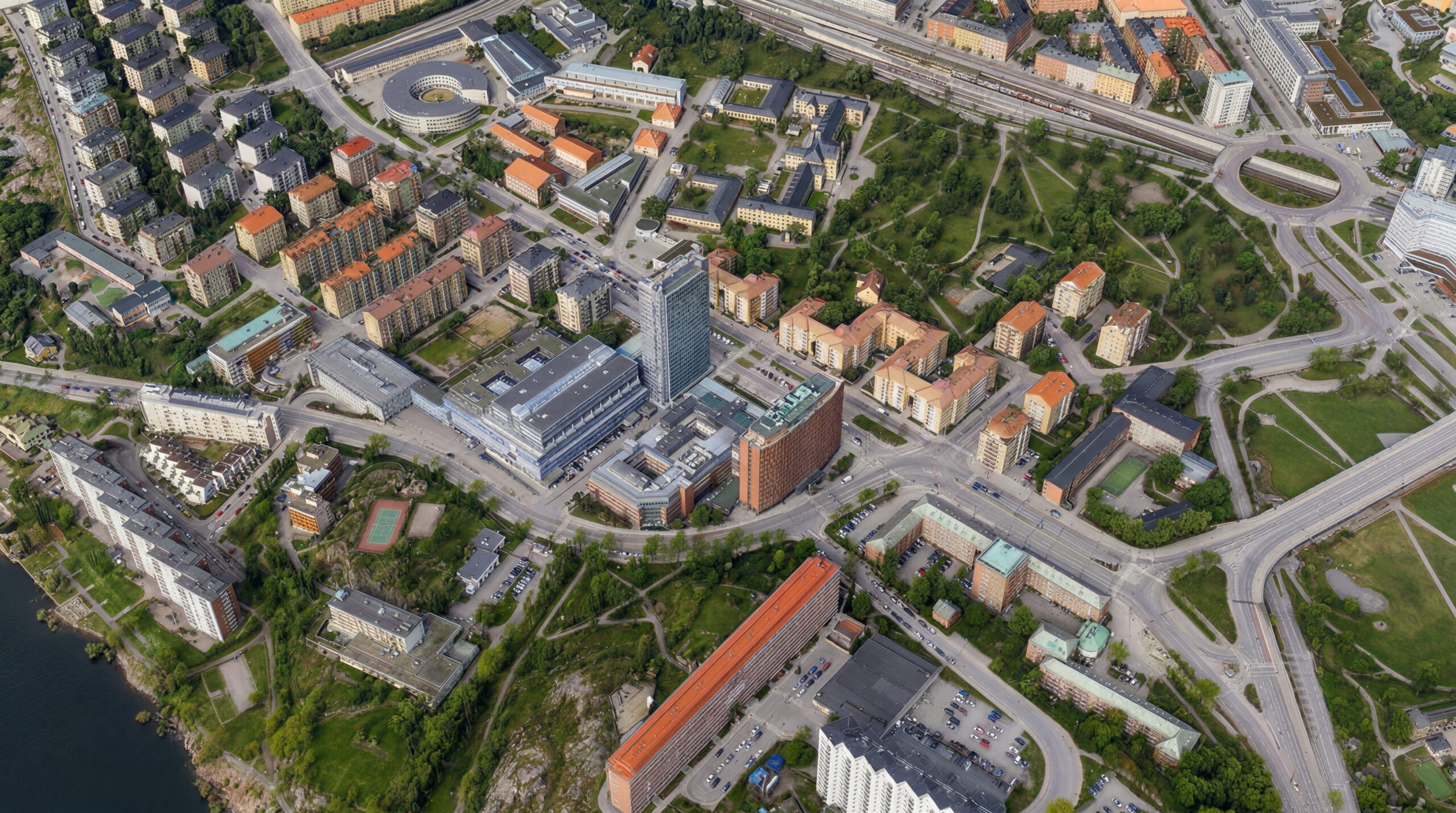
Use Case 1. Innovation Arena Tidningskvarteren develops a digital twin for circular urban economy at city district level.
The chosen geographical area is in the centre of Stockholm where two NextArc partners have their headquarters: Sweco and http://www.swegreen.se.
With a focus on stakeholder interaction at neighbourhood scale, the use case is fully aligned with the city’s Climate Action Plan 2030. Stockholm is one of 100 European cities that take a leading role in climate transition through SCALE Stockholm: Stockholm Pilot City for Climate and Health.
NexTArc contributes innovative models for stakeholder interaction and citizen participation with the aim to equally reduce climate impact and benefit health and wellbeing: so-called double-duty actions for climate and health.
This reflects measures currently taken by several European cities that face triple challenges to reduce CO2 emissions at the same time as urban development is needed to meet current housing demands and social sustainability goals.
Read more: https://www.sweco.se/aktuellt/nyheter/tidningskvarteren-i-stockholm-blir-digital-innovationsarena/
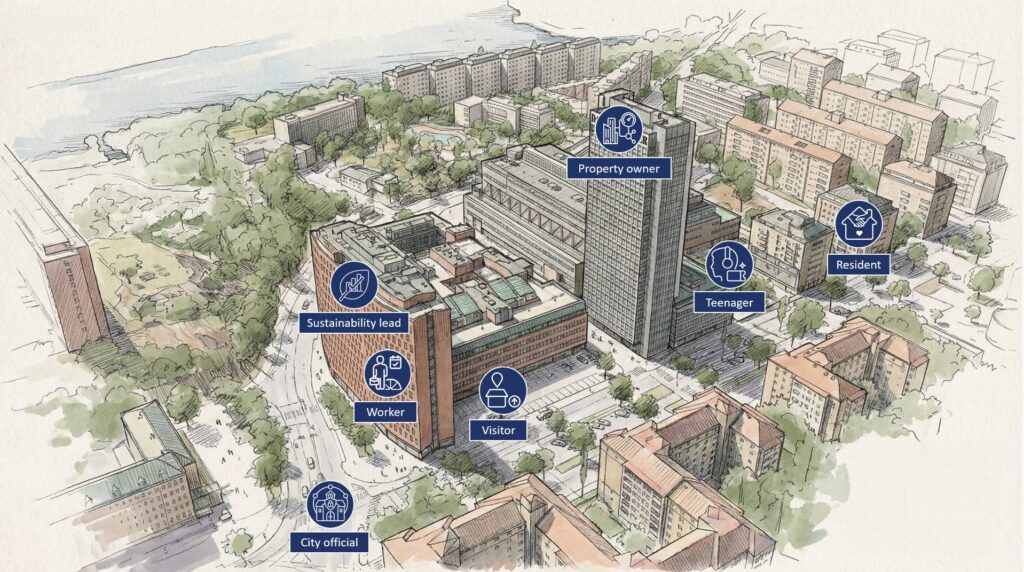
About 8000 people work and live in the area.
A digital twin for circular urban economy
Resource-sharing requires novel approaches in terms of urban digital twins that can optimize system-level approach enabling sharing of resources and data; carbon management models to monitor multiple value chains; and data sources from a broad spectrum of stakeholders.
The Use Case addresses the challenge from sensor development to the complexity of a circular urban neighbourhood.
This will be achieved through an interdisciplinary design approach to develop an urban digital twin for an AI-supported circular economy model.
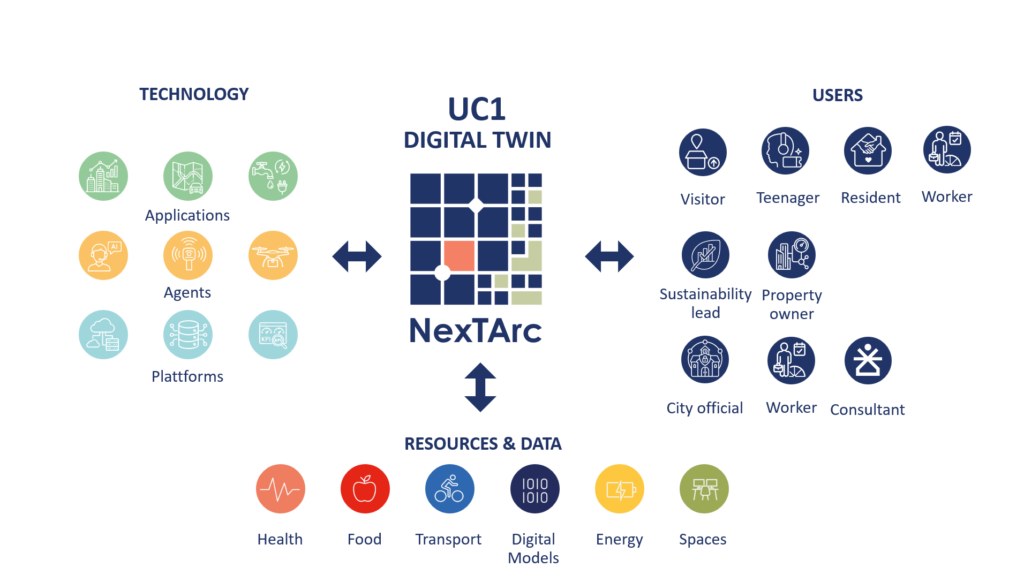
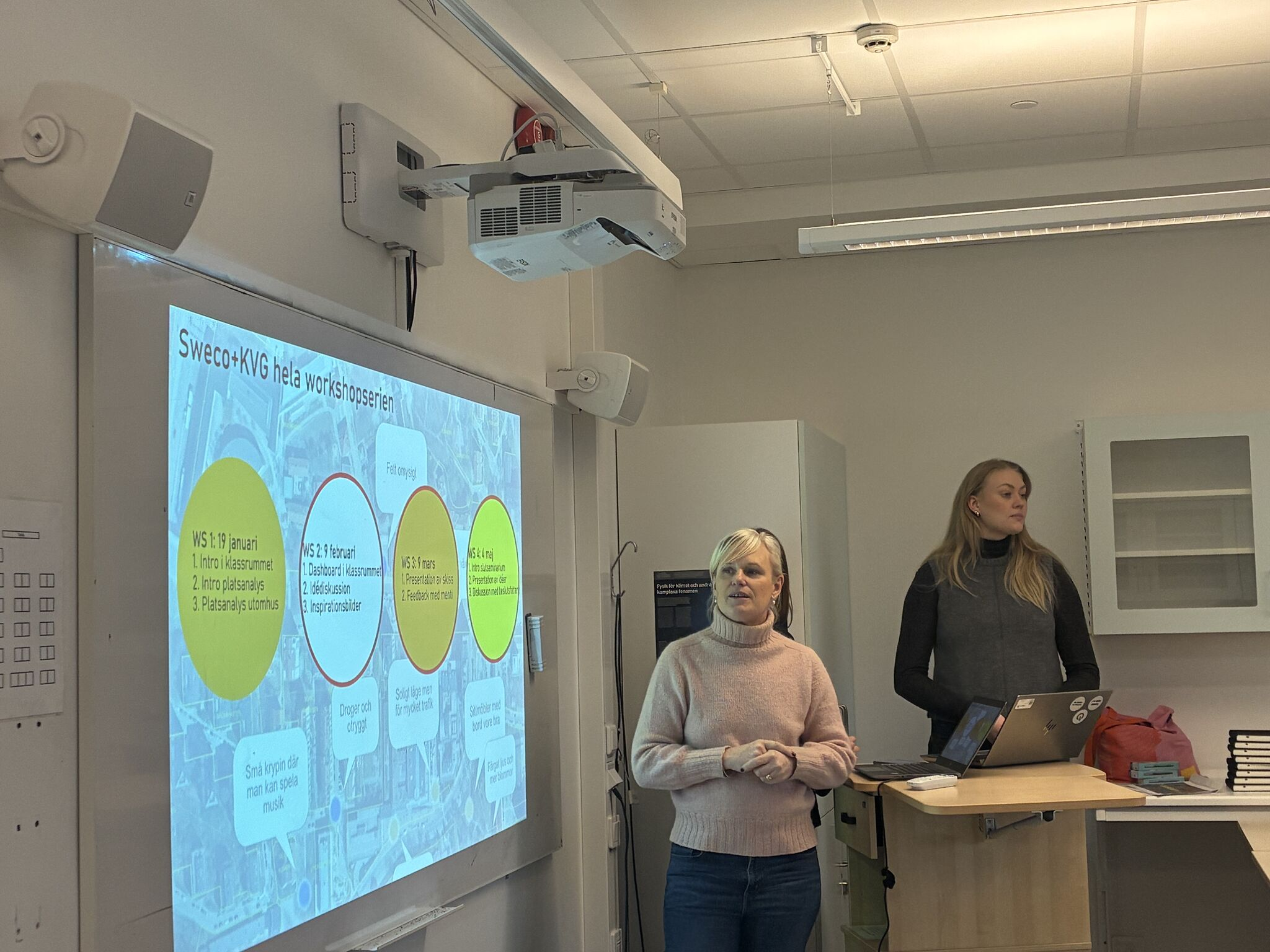
Innovation Arena Tidningskvarteren engages local actors and citizens in local initiatives to nudge e.g. sustainable mobility and urban sharing of resources through design and temporary interventions in public space.
The Use Case explores how presence and prediction technologies, AI and agent development may support an integrated system that optimizes e.g. resource, space and data sharing, energy, sustainable mobility and urban food production.
An AI-supported circular economy model develops through an iterative design process with local stakeholders, experts and researchers within NexTArc.
See a full list of NextArc Demonstrations at UC1 here:
Demonstration #1.1 Adoption of a Dependable Digital efficient city Twin (dDT) for decision-making for multiple stakeholders
Demonstration #1.1 Adoption of a Dependable Digital efficient city Twin (dDT) for decision-making for multiple stakeholders having conflicting objectives (KI3.2 is central to all demonstrations in UC1, besides its own contribution, it will also integrate all other inputs). This demonstration is based on the integration of heterogeneous data sources. At the core of the dDT are the visualisation services adapted to the needs of specific users dealing with mainly energy optimisation of infrastructures with different sizes and complexity using population-based AI-search methods: (a) SWEG’s indoor farm supervision, (b) SWECO office buildings management, (c) DN-Tower incl. EV charging units and the solar panels on the roof (KI4.2 ). In addition, mobility-traffic-logistics planning for SWECO and DN-Tower office workers, and other commuters in the area will also be implemented (KI4.1). This demonstration assumes the 163 The project team will seek to integrate UC1 with either of the two strategic initiatives that Stockholm is involved in to reach climate-neutrality by 2030: NetZeroCities and Viable Cities (www.viablecities.se). 29 integration of various IoT and embedded systems (sensors, computing, and control units). As part of the system are also various SW for controlling sub-systems found in these 2 towers (KI3.2 and KI2.5 will be used in the above-mentioned together with all KI1.n for cyber-security, and KI2.5 for trustworthy AI-related computing). The dDT will allow situational awareness in (sub-second) real-time and, decision-making in the context of daily interaction with the buildings’ infrastructure, mobility and logistics activities. The dDT also becomes a platform for developing novel services to meet the needs of the citizens, from energy saving to planning influx/outflux of people and goods in the Marieberg city district. Demonstration #1.1 will integrate all other demonstrations in UC1 to provide a holistic view.
Demonstration #1.2 Multi-dimensional service and resource planning
Demonstration #1.2 Multi-dimensional service and resource planning is, simply put, at the core of a complex planning problem that involves the planning of (i) base electricity usage of the DN-Tower building, (ii) EV charging, and (iii) the weekly need of the SWEG indoor farming infrastructure (all concerning the DN-Tower) (KI3.1-2 will be support traffic/mobility flows). In this demonstration nudging the EV owners will also be part of the demonstration (A VR-based GUI for citizens based on KI3.2 dDT will be used for this purpose). The objective is the lower the peak electricity consumption by informing the vehicle owners when to charge the EVs during the coming week, based on the outcome, plan the SWEG’s electricity plan and, at the same time plan all the rest of the needs after all key stakeholders are satisfied. The existing solar energy infrastructure found at the DN-Tower will be integrated into the system to see if also the total electricity cost can be lowered. KI2.6 will support this demonstration from the logistics perspective in a human-like way so that the stakeholders can better plan the positioning of EV chargers for improved energy efficiency.
Demonstration #1.3 Implementation of smart HVAC Add-On Functionality for Grid Stabilization through FCR-D Services
Demonstration #1.3 Implementation of smart HVAC Add-On Functionality for Grid Stabilization through FCR-D Services This proposal involves the implementation of advanced HVAC management functionality within commercial buildings, specifically designed to contribute to Frequency Containment Reserve for Disturbances (FCR-D) up and down services. By dynamically adjusting the HVAC system’s energy consumption in real time, this system will assist in stabilizing the electrical grid by responding to frequency deviations. The HVAC system will be integrated with an extended IoT platform, featuring high connectivity to enable 24/7 monitoring and management of parameters related to building climate control and energy usage. This integration will allow the building to contribute to FCR-D without compromising indoor air quality. Overall, this functionality can be a key contributor to grid flexibility and stability, seamlessly integrating with existing building management systems and providing critical support for a building’s operational sustainability. This initiative aligns with Svenska kraftnät’s framework for system services and, if implemented at scale, would unlock a vast amount of potential FCR-D resources. Svenska kraftnät is the authority responsible for ensuring that Sweden’s transmission system for electricity is safe, thus, this demo will have a wide impact on UC1.
Demonstration #1.4 Multiple and distributed indoor farming solutions, incl. CO2 capturing, through federated learning
Demonstration #1.4 Multiple and distributed indoor farming solutions, incl. CO2 capturing, through federated learning is based on 5 (five) currently operating large farming units situated in indoor areas (e.g., dedicated areas in supermarkets) across Stockholm, Solna, Linköping, Gothenburg, and Uppsala. As the first step, CO2 capturing will be implemented, leading to energy planning for the host building. The farming unit will have an extended IoT platform with high connectivity (MQTT broker+PLC), allowing for 24/7 monitoring and management of over 100 parameters related to the growing environment, climate, and input management (KI3.2 will be adapted to this problem). The system will be designed to autonomously monitor and adjust key factors, including the HVAC and air handling unit, nutrition management system, and LED lighting, to optimize the growing process and reduce energy costs. The solution will be also based on both captured and added CO2 in the DN-Tower office facilities (K3.3 is key for secure operations). Edge AI functionality and analysis tools will be provided from STREAM. This demonstration will be based on Demonstration #1.2-3, which focuses on different aspects of individual units. In Demonstration #1.4, the objective is to show how the indoor farming solution can be scaled up through federated learning and enhanced autonomous operation. These advancements will allow the development of an unlimited number of farming units from various locations that show different degrees of integration with their host buildings and operate with minimum human assistance. The outcome of this demonstration is important for developing resilient food production solutions in urban areas. Demonstration #1.4 will also deal with farm-2-fork servitisation, and in that context extend Demonstration #1.2-3 to incorporate other stakeholders, such as restaurants, retail, and citizens. KI2.5 will be utilised for setting up a trustworthy AI framework that will be integrated with the dDT over KI3.2. KI4.1 will support decentralised accountability and federated learning for training the AI algorithms used for optimising indoor farming and production.
Demonstration #1.5: Noise pollution monitoring in urban traffic zones
Demonstration #1.5: Noise pollution monitoring in urban traffic zones aims for real-time noise level monitoring and mapping showing the spatial distribution and intensity of various types of noises, e.g., traffic, in the district (KI3.2 will be supporting traffic/mobility flow calculation and visualisation). The novelty of this demonstration is realised with the use of smart visual and acoustic cameras where (i) large area of the district can be accurately mapped with relatively few devices (compared to a single-mic sound monitoring station), (ii) noisy sound sources will be accurately localised and triangulated via machine learning-driven microphone array localisation algorithms and AI-based visual object classification, (iii) on-edge processing of 30 visual and acoustic data will allow analyses of the measured noise to identify various sources such as cars, trucks, motorcycles, drones, aircraft, and alarms by considering situational awareness functions provided by KI2.2. Coupled with the digital twin system, this provides insights to the stakeholders on the noise situation and how to autonomously control noise pollution in the area, e.g., imposing lower speed limits or access hours, and diverting traffic based on the noise emission of the vehicles. In the long term, it also allows stakeholders to evaluate noise mitigation measures such as vegetation, barriers, and pavement materials.
Demonstration #1.6 Secure and privacy-preserving protocols for smart grid systems
Demonstration #1.6 Secure and privacy-preserving protocols for smart grid systems One key innovation in the area of security, trustfulness, and privacy for load management is the development of secure and privacy-preserving protocols for smart grid systems. These protocols ensure that sensitive information, such as mobility and electricity data, is protected from unauthorized access, manipulation and misuse while still enabling effective load management strategies. KI1.2 and KI2.5 will be used as low-level hardware-based solutions to enable security and privacy at the edge by considering both things and persons authentication and trusted AIoT. KI4.1 will improve the accountability and privacy of users over the grid system considering the fair use of electricity in dDT (KI3.2)
UC1 Objectives
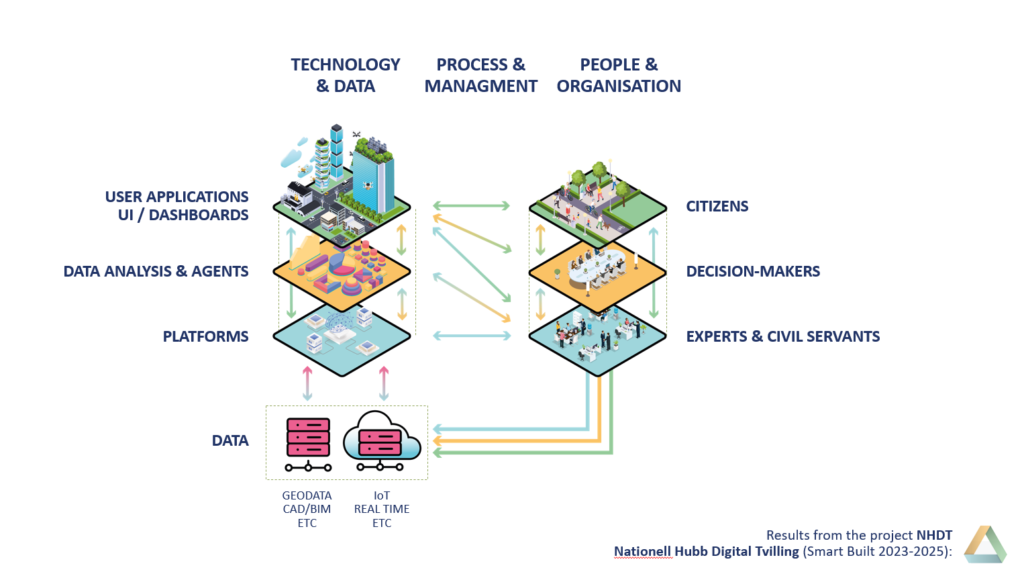
UC1 is inspired by the Digital City Twin approach that aims to tackle problems in urban areas and provide powerful tools for urban planners and policymakers to visualize, simulate, and optimize various aspects of city life. UC1 will focus on realizing the conventional solution strategy of digital twin by integrating i) Realtime Data Integration (buildings through building management systems, energy resources like solar panels and energy management systems including the energy grids and infrastructure, indoor production systems like indoor farms, logistics nodes like vehicles and goods, noise pollution monitoring systems, people and vehicle mobility monitoring systems, etc.); ii) Immersive Visualization enabling stakeholders to explore the digital city twin through immersive 3D visualizations and virtual reality (VR); iii) Advanced analytics algorithms analyse historical data and real-time trends to generate predictive insights on future urban dynamics; iv) Scenario Simulation, e.g., “what-if” scenarios and evaluate the potential impact of different policies, projects, or events on the city’s infrastructure and quality of life. The planned demonstrations (1-6) of UC1 will focus on informed Decision-Making, efficient resource allocation and sustainable development to be showcased in Marieberg city district in central Stockholm considering the integration with physical and virtual twins considering 5 main application areas (each associated with the demonstrations): i) Energy-efficient and eco-friendly Building Management and its integration with district-level infrastructure; ii) EV Charging and Logistics Planning connecting smart buildings with smart city services; iii) Analysing people’s and vehicles’ movement to improve the efficiency of influx/outflux mobility (i.e. for vehicles’ traffic open traffic monitoring services and active noise maps will be jointly used); iv) sustainable development and production in cities by focusing on indoor (vertical) farming as a case study (also covering its supply chain and circular economy practices); v) Improved citizen comfort and wellbeing by developing strategies and decision-making against noise pollution.